Why is learning English in school important for students' futures?
Today, learning English is no longer just an elective subject in the school curriculum.
It has become a tool that can open up opportunities academic, professional, technological, and cultural throughout one's life.
That's why, when a family is looking for a School in Funza with a focus on English, it's worth looking far beyond the number of hours listed on the schedule.
The real question should be:
Is the student learning English to pass a class, or is he or she developing skills to truly communicate?
Because learning a language isn't just about memorizing vocabulary lists, translating sentences, or doing exercises.
It involves developing the ability to understand, speak, read, and write in real-life situations.
And the sooner that process begins, the more opportunities the student will have to make steady progress.
English has become a tool for today's world
We live in an increasingly connected world.
Much of the information available online—including academic content, research, technological tools, courses, and international opportunities—uses English as one of its primary languages.
For this reason, a student who develops English language skills can gain access to more resources during his or her educational journey.
You can:
Understand content that isn't always available in Spanish.
Explore new sources of information.
Access international courses.
Interact with people from other countries.
Function more easily in various academic and professional settings.
Learning English starting in elementary school allows students to build that skill gradually, rather than having it become a challenge that must be overcome in a rush by the time they finish high school.
Why start at an early age?
Learning a language takes time.
It's not a skill that develops overnight.
That is why, when English is taught starting in the early school years, students have more opportunities to become familiar with the language's sounds, expressions, vocabulary, and structures.
But above all, he has more time for something essential:
Overcoming the Fear of Communicating.
Many adults have studied English for years, know the grammar rules, and understand some words, but feel unsure of themselves when they need to speak.
That's because learning a language based solely on theory doesn't always build communication confidence.
When students are frequently exposed to English in school, they can begin to use it more naturally.
Learning English shouldn't just mean memorizing vocabulary
One of the traditional methods of teaching languages has been based on memorizing long lists of words:
Colors.
Animals.
Numbers.
Verbs.
Careers.
Food.
All of that vocabulary is necessary.
But knowing words doesn't necessarily mean knowing how to communicate.
A student can memorize hundreds of terms and still have trouble holding a simple conversation.
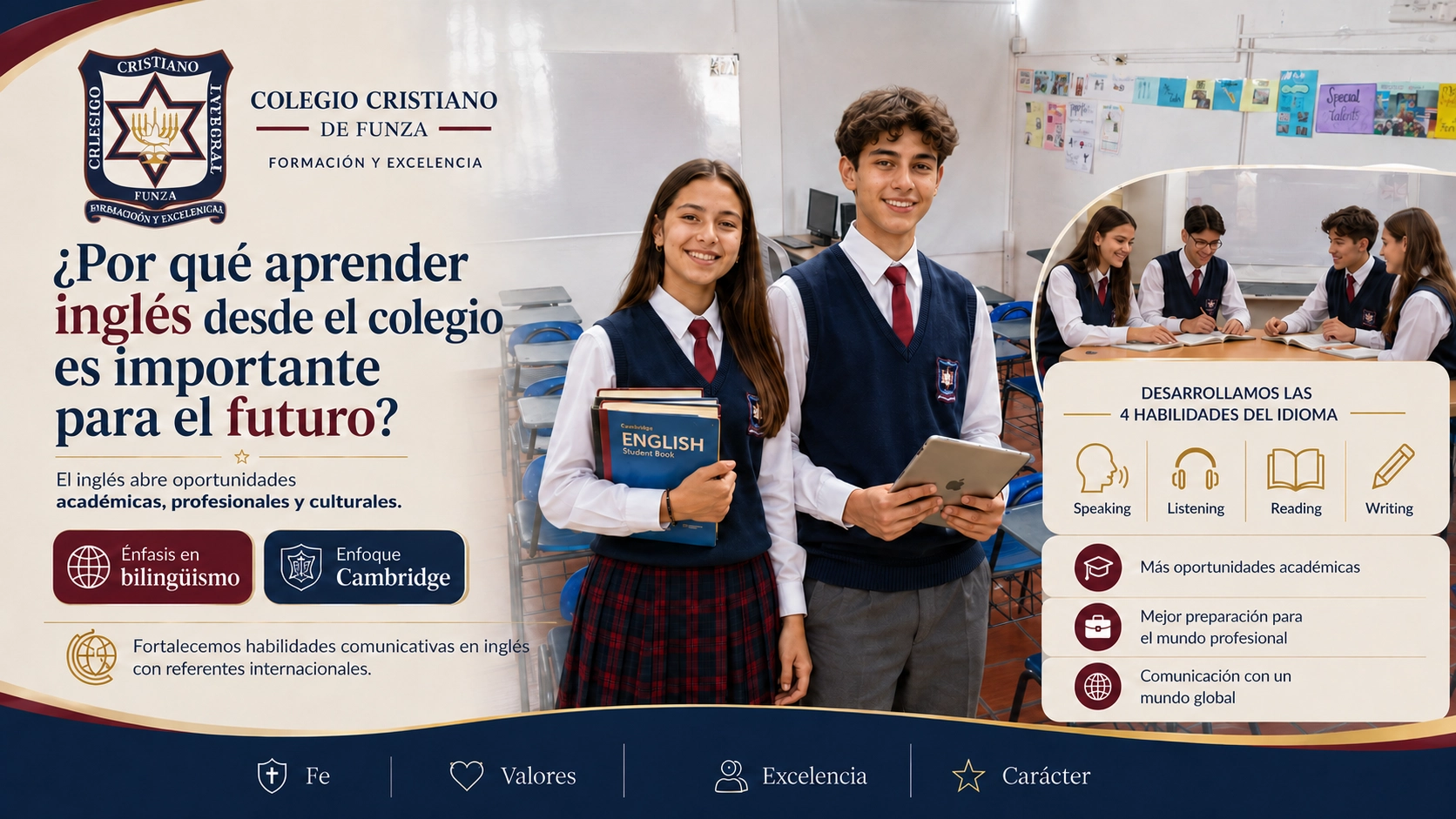
Therefore, future-oriented English instruction must develop four fundamental skills in a balanced way.
Listening: Understanding What You Hear
Listening helps you get used to different pronunciations, speaking speeds, and ways of expressing yourself.
Videos, audio recordings, conversations, and interactive activities can help students gradually develop this skill.
Speaking: Learning to Express Yourself
Speaking is one of the skills that requires the most practice.
Students should have opportunities to answer questions, participate in conversations, give presentations, describe situations, and express ideas.
Making mistakes is part of learning.
The goal is for them to gradually gain confidence.
Reading: Understanding Texts
Reading helps expand vocabulary and develop comprehension.
Depending on their age, students can work on everything from simple instructions to longer texts, articles, stories, or academic material.
Writing: Communicating Ideas in Writing
Writing helps you organize your thoughts and use language structures correctly.
You can start with simple sentences and move on to more complex texts as the student's skill level improves.
English can be integrated into everyday school life
For a language to become a practical tool, it needs to appear frequently in the student's environment.
It shouldn't be limited solely to the moment the English class begins.
There are different ways to increase exposure to the language, for example:
Greetings and everyday expressions.
Simple instructions.
Cultural activities.
Songs.
Readings.
Projects.
Presentations.
Digital tools.
Audiovisual material.
Guided conversations.
When this happens, the student begins to associate English with situations and contexts, not just with a book.
What does it mean to have a focus on bilingualism?
It's important to clarify something.
A school can develop a Emphasis on bilingualism and improving English proficiency without claiming that it is officially a certified bilingual school.
They are different concepts.
Having a focus area means that the institution develops strategies, academic intensity, methodologies, and processes to progressively strengthen students' proficiency in a second language.
This may include activities designed to develop:
Listening Comprehension.
Oral expression.
Reading.
Writing.
Official certification as a bilingual institution depends on specific requirements, processes, and accreditations.
That is why communication with families must be clear and transparent.
In the Funza Christian School The school places an emphasis on bilingualism aimed at progressively strengthening English proficiency, although it is not currently certified as a bilingual school.
What are the benefits of a Cambridge-based approach?
Cambridge English is an international benchmark for English language learning and assessment.
An approach based on these guidelines makes it possible to structure the learning process around the development of communication skills.
That means making steady progress in skills related to:
Listening Comprehension.
Oral expression.
Reading.
Writing.
Vocabulary.
Language Structures.
Ability to communicate in different situations.
The goal shouldn't be to teach English just so students can pass a test.
The goal is to use international benchmarks that allow for the organization of learning in a progressive and measurable way.
At the Funza Christian School, academic work can incorporate content, methodologies, and skills aligned with what these types of standards assess and promote, without stating that the school currently holds bilingual certification.
This allows us to work toward ever-higher levels of mastery as the institutional process unfolds.
The goal isn't just to know English, but to be able to use it
There is an important difference between knowing a language and being able to use it.
A student may know that a sentence is grammatically correct.
But in real life, you'll have to understand another person, think of a response, and express it.
For this reason, one of the main goals should be to develop communication skills.
The student should be able to:
Introduce yourself.
Ask questions.
Explain an idea.
Understand instructions.
Participate in conversations.
Read the information.
Write messages.
Give presentations.
Solve problems using language.
When this happens, English really starts to become a useful tool.
More academic opportunities
English can have a direct impact on higher education.
Many universities use textbooks, research papers, and reference materials in this language.
There are also exchange programs, international courses, scholarships, and study abroad opportunities that require a certain level of English proficiency.
A student who begins to develop this skill in elementary school may be better prepared to take advantage of these opportunities.
In addition, you can access a wider range of academic and technological content.
More career opportunities
The job market has also changed.
There are currently Colombian companies that work with international clients.
Foreign organizations hire talent in different countries.
Virtual meetings make it possible to work with people located anywhere in the world.
That's why English can broaden your career opportunities.
Knowing the language doesn't automatically guarantee a job.
But it can become a key competitive advantage when combined with technical and professional knowledge and personal skills.
English, Technology, and Education for the Future
The relationship between English and technology is growing ever closer.
Many programming languages, platforms, courses, technical documentation, and digital tools use English terms.
A student interested in programming, engineering, design, artificial intelligence, or other technology-related fields will constantly come across content in this language.
That is why improving English skills can complement other educational opportunities.
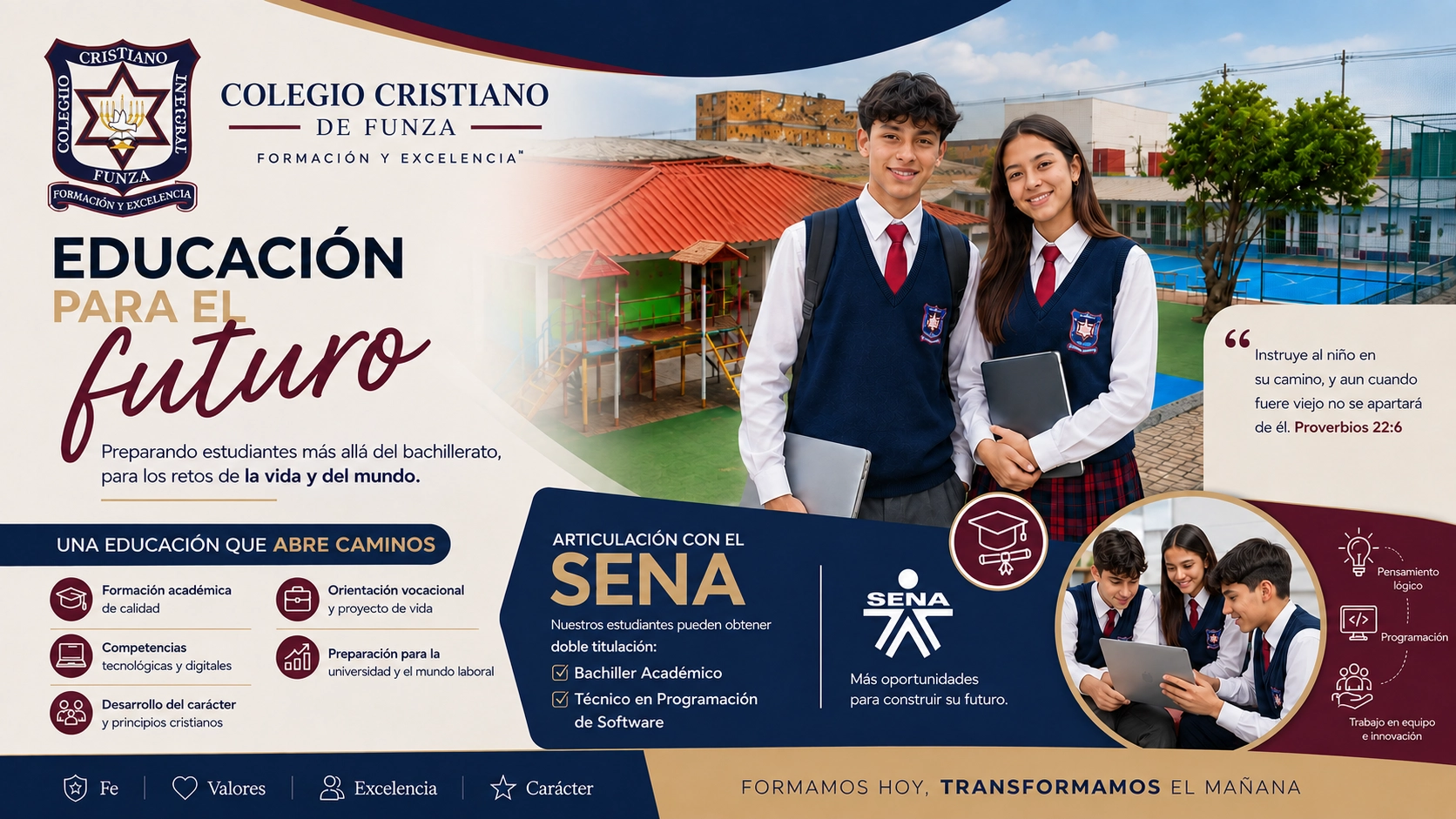
In a model designed to prepare students for life beyond high school, English language learning can be integrated with other areas such as technology, programming, technical training, and college preparation.
It is also a gateway to other cultures
Learning a language has more than just academic or career benefits.
It also allows us to discover other ways of thinking about and understanding the world.
Through English, students can access literature, music, science, history, documentaries, and content produced in different countries.
This can help foster curiosity and a broader perspective on the world around us.
Learning another language does not mean losing one's identity.
It means gaining a new tool for understanding and communicating with other cultures.
What should parents ask about English instruction?
When a family is evaluating a school, it can be helpful to ask:
How is English taught at each grade level?
Do they develop speaking, listening, reading, and writing skills?
Do students have real opportunities to speak English?
Is there an emphasis on bilingualism?
What international standards does the school use?
How is student progress measured?
Is English taught only as part of the course, or is it also taught through other experiences?
What goal does the institution hope to achieve with its students?
These questions help distinguish between simply offering an English class and having a structured process for language development.
Not all students progress at the same pace
Learning a second language is a process.
Some students quickly develop listening skills.
Others feel more comfortable reading.
Some people are natural speakers.
Others need more time to gain confidence.
That is why it is important to view learning English as a gradual process.
Support, consistent practice, and exposure to the language can be just as important as academic content.
English as Part of a Well-Rounded Education
Preparing students for the future requires more than just one skill.
English can open doors.
Technology can create opportunities.
An academic education provides knowledge.
Character development helps us make decisions.
Christian principles provide a foundation for using those abilities purposefully.
For that reason, these areas should not operate independently.
A well-rounded education seeks to connect them.
In the Funza Christian School, strengthening English skills is part of an educational vision that seeks to prepare students not only to graduate from high school, but also to continue thriving in an increasingly connected world.
Learn today to have more opportunities tomorrow
It is impossible to know exactly what opportunities students will have in ten or fifteen years.
But we can equip them with tools that will improve their chances.
English is one of them.
That is why learning it in school should not be viewed simply as fulfilling a course requirement.
It should be viewed as a long-term investment in education.
A tool that can support students:
At college.
In his profession.
On his travels.
In technology.
In new experiences.
In ways we may not yet be aware of.
Because educating for the future also means preparing students to communicate with an increasingly connected world.
Frequently Asked Questions
Is the Funza Christian School a certified bilingual school?
Currently, the institution is developing a Emphasis on bilingualism and improving English proficiency, but it does not identify itself as a certified bilingual school.
What does it mean for a school to use the Cambridge approach?
This means that, as part of the teaching process, reference points, competencies, and methodologies aligned with the international standards promoted by Cambridge can be used to develop skills such as speaking, listening, reading, and writing.
Do students receive a Cambridge certificate?
Working on content or skills aligned with the Cambridge approach does not automatically mean that every student receives a certificate.
Certifications are contingent upon exams, procedures, and specific requirements.
The institution must clearly communicate which certifications or tests are available at any given time.
Why is it important to start learning English in school?
Because it allows students to gradually develop their comprehension, vocabulary, pronunciation, and confidence in communication, while also preparing them for future academic and professional opportunities.
What skills should be developed in addition to vocabulary?
A comprehensive language learning program should focus primarily on listening comprehension, speaking, reading, and writing.
Learn about our English track
In the Funza Christian School We believe that preparing for the future also means providing tools that enable our students to thrive in a connected world.
Our emphasis on bilingualism It aims to progressively strengthen students' English communication skills and expose them to international role models in learning.