Education for the Future: School Shouldn't Just Prepare Students to Graduate
For many years, one of the main goals of school education was clear: to complete high school and earn a diploma.
But today, that goal is no longer enough.
The world of work is changing rapidly, new professions are emerging, technology is transforming entire industries, and young people must make decisions about their future at an increasingly early age.
That's why, when a family is looking for a school in Funza, it's worth asking a different question:
Is this school preparing my child just to graduate, or is it also preparing him for what comes next?
Education for the future should help students develop knowledge, skills, competencies, and experiences that will enable them to be better prepared for college, the workforce, and the pursuit of their own life goals.
What does it mean to prepare a student for the future?
Preparing for the future doesn't mean trying to predict which profession will be in highest demand ten years from now.
It means providing tools that will remain useful even as the world changes.
A student needs to learn math, science, languages, technology, and other core subjects.
But it also needs to develop capabilities such as:
Critical thinking.
Troubleshooting.
Communication.
Teamwork.
Autonomy.
Responsibility.
Use of digital tools.
Adaptability.
Leadership.
Career guidance.
That is why a well-rounded education should connect what happens in the classroom with real-life situations and opportunities.
The challenge begins after 11th grade
For many students, graduating from high school is one of the first major turning points.
Upon graduating from high school, questions such as the following arise:
What am I going to study?
Am I ready for college?
What skills do I actually have?
How can I start gaining experience?
What job opportunities are available to me?
Am I sure about the major I want to choose?
When a young person reaches 11th grade without having had any prior exposure to different professional or technical fields, making these decisions can be much more difficult.
That is why it is important for schools to begin introducing students to the professional world before they finish school.
Collaboration with SENA as an Opportunity During High School
One of the distinguishing features that can add significant value to students' education is the collaboration with SENA.
This type of program allows students to supplement their traditional academic education with technical training and the development of skills applicable to real-world contexts.
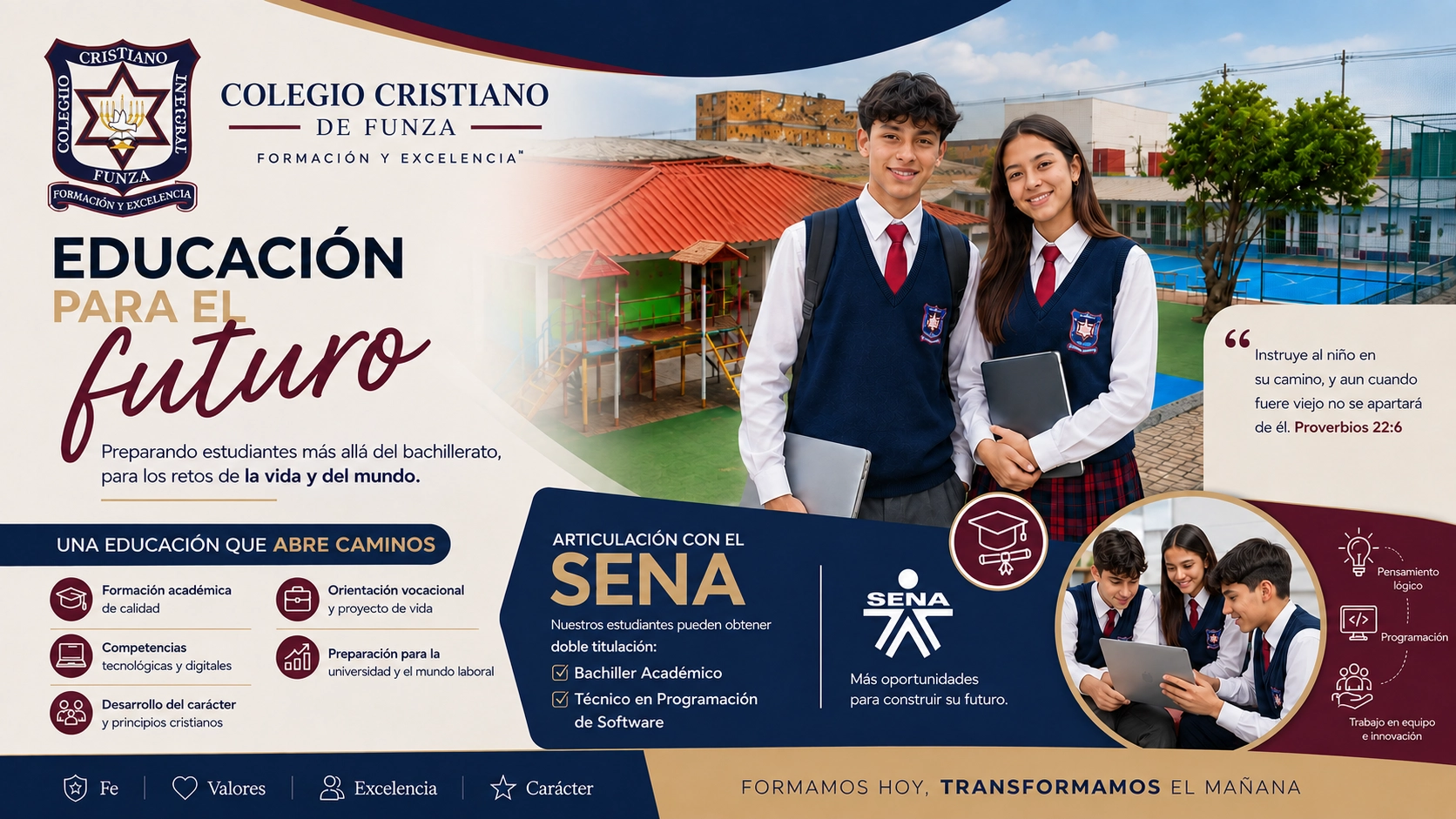
In the case of the Funza Christian School, students have the opportunity to advance their academic education while developing additional skills through a partnership with SENA.
This means that the school doesn't just focus on graduation.
It also aims to provide tools that can support students as they move on to the next stage of their lives.
Why is it important to start technical training in elementary school?
Technical training can offer several benefits to a student.
1. It helps you discover your career interests
Not all young people are entirely sure what they want to study as they approach graduation.
Being in contact with technical fields allows them to experiment, learn about new possibilities, and discover skills they may not have realized they had.
This can help them make more informed career decisions.
2. Turn knowledge into practical experiences
One of the major challenges in education is helping students understand how they can apply what they are learning.
Technical training facilitates that connection.
Students can develop projects, solve problems, and tackle situations that require them to apply their knowledge in a practical way.
In this way, learning is no longer just about memorizing content.
It becomes do, create, and solve.
3. Builds skills for college
Technical training does not necessarily mean that a student will stop pursuing a college degree.
On the contrary.
It can help you gain a clearer understanding of the field you want to study and develop additional skills.
Learning to work on projects, meet deadlines, conduct research, use tools, and overcome challenges can also ease the transition to higher education.
4. Expands opportunities after school
Every student follows a different path.
Some will go on to college right away.
Others may want to supplement their education.
Some people might start working while they're in school.
That is why it is important for young people to have a variety of tools and opportunities available to them when they finish high school.
High School and Technical Training: Two Paths That Can Complement Each Other
For a long time, technical education and college education have been portrayed as if they were opposing paths.
They aren't necessarily.
A student can receive technical training in high school and then go on to pursue vocational studies.
The important thing is that you have more tools to help you make a decision.
The education of the future should aim for precisely that:
Expand possibilities rather than limit options.
Technology and Programming: Skills That Are Becoming Increasingly Important
Digital transformation is changing virtually every industry.
Today, technology is used in medicine, administration, tourism, commerce, agriculture, education, logistics, engineering, marketing, and many other fields.
For this reason, developing skills related to programming, logical thinking, and technology can be a significant advantage for students.
That doesn't mean everyone has to become a programmer.
It means that understanding how technology works allows them to interact with today's world in a different way.
When a student learns to program, they also develop skills such as:
Logical reasoning.
Troubleshooting.
Creativity.
Analysis.
Perseverance.
Organization.
Structured thinking.
These skills can be useful even if you ultimately decide to pursue a completely different major.
An education that connects high school, college, and the workforce
School shouldn't be treated as a phase that's completely separate from the rest of life.
Ideally, there should be a connection:
High school → continuing education → higher education → professional life.
When these stages begin to come together, students can develop a more conscious life plan.
That is why partnerships, agreements, and programs that expose young people to new experiences during their school years are important.
Collaboration with institutions such as SENA can serve as one such bridge.
What should parents ask when choosing a school?
When a family is looking for a school in Funza, typically comparing factors such as facilities, academic standards, costs, location, and languages.
But it would also be worth asking:
What opportunities will my child have before graduating?
Does the school have agreements or partnerships with other institutions?
Do students have exposure to technical or professional fields?
Is there career counseling?
Are digital skills being developed?
Do students work on practical projects?
What resources do you receive to help you prepare for college?
How can you support the development of your life plan?
These questions can reveal a great deal about an institution's educational vision.
A diploma matters, but what a student can do matters even more
Graduating is a major accomplishment.
However, when a young person enters the real world, they will begin to face situations where no one will ask them only about their grades.
You'll also need to show what you can do.
How to Communicate an Idea.
How he works with others.
How he solves a problem.
How it uses technology.
How he learns something new.
How he responds to a challenge.
How he makes decisions.
That is why education should help develop both knowledge and skills.
Academic, Technical, and Character Education
Preparing for the future doesn't mean focusing exclusively on job skills, either.
A young person may have excellent technical skills and still need solid principles to guide their decision-making.
That is why a truly comprehensive education must address different dimensions at the same time.
Education, to develop knowledge.
Technical Training, to develop practical skills.
Character Development, to learn how to use those abilities responsibly.
Christ-centered education, to build principles, purpose, and identity.
When these areas complement each other, students receive a much broader education that prepares them for the next stage of their lives.
Why should these opportunities start in school?
Because the future doesn't begin after graduation.
Construction begins much earlier.
Every project.
Each skill.
Every experience.
Every decision.
Every opportunity to discover a talent.
Everything can influence the path a student will take in the future.
That is why a school that is focused on education for the future does not just ask:
What does this student need to learn to pass the year?
He also asks:
What tools will this young person need to build a life for himself?
Preparing students for opportunities that don't yet exist
Many of the careers that today's children and young people will pursue are still evolving.
Some might not even exist today.
This means that one of the most important skills will be continuous learning.
The student of the future will need:
Adapt.
Stay up to date.
Learning new technologies.
Working with different people.
Solve problems we don't yet know about.
That is why education must evolve.
The goal can no longer be simply to provide information.
It should help develop people who are capable of learn, create, adapt, and move forward.
An education that looks beyond high school
When a family chooses a school, it is making a decision that can have an impact for many years to come.
That is why it is important to consider not only what the student will learn in the next grade.
It's also worth considering what opportunities will be available to them throughout their education.
Collaboration with SENA, a focus on technical skills, technological development, and preparation for higher education can become important tools for students.
Because a school that is truly committed to the future doesn't just support students until the day they graduate.
It aims to provide you with the tools you need to keep moving forward after it.
Frequently Asked Questions
What is the partnership between a school and SENA?
It is a process that allows students to supplement their high school education with technical training and the development of specific skills during their final years of high school, in accordance with the programs and conditions established between the institutions.
Can a student graduate with additional education beyond high school?
Depending on the articulation program in place, students can simultaneously advance in their academic studies and in complementary technical training.
It is important to check directly with the school to find out the current program requirements.
Does technical training replace college?
No.
You can supplement it.
A student can develop technical skills during high school and then go on to pursue technical, college, or other educational programs.
What are the benefits of learning to code in school?
In addition to digital skills, programming can strengthen logical thinking, analysis, creativity, and problem-solving—skills that are useful in various professional fields.
Why is it important to choose a school that prepares students for life after 11th grade?
Because decisions made after high school require skills, guidance, and experiences that, ideally, should begin to be developed before graduation.
Learn about the opportunities we offer our students
In the Funza Christian School We believe that education should prepare our students for much more than just receiving a diploma.
We aim to provide you with experiences and opportunities that will enhance your education academic, personal, spiritual, and professional.